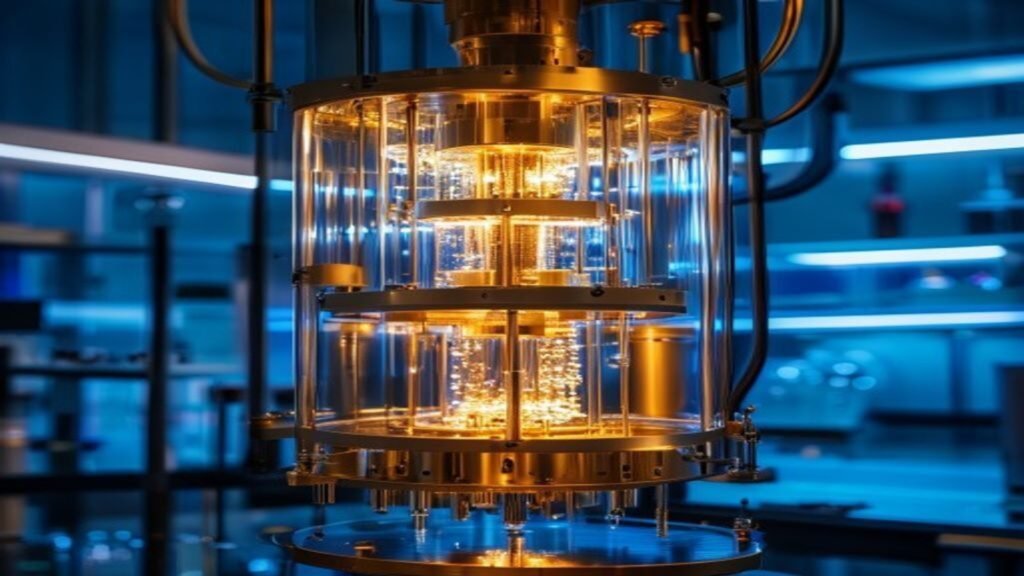
For decades, quantum computing occupied a strange cultural niche: perpetually revolutionary, perpetually a decade away. That era is ending. A series of error-correction breakthroughs at major American labs has moved the field across a threshold physicists long described as the hard part — demonstrating that quantum information can be protected and scaled rather than dissolving into noise. The machines remain exotic, but the roadmap has changed from question mark to engineering schedule, and American businesses have begun treating quantum as a when, not an if.
What Actually Changed
The breakthrough that reset expectations was logical qubits — error-corrected clusters of physical qubits that perform more reliably as they scale. Multiple labs, using competing hardware approaches, demonstrated that adding qubits can reduce errors rather than multiply them, the foundational requirement for useful machines. Industry roadmaps now converge on fault-tolerant systems within the decade, and the race has shifted from raw qubit counts — long a misleading vanity metric — to the quality and connectivity of error-corrected logical operations.
The First Real Customers
Commercial quantum value is arriving the way most technologies arrive: narrowly, then broadly. Pharmaceutical companies use early machines alongside classical supercomputers to model molecular interactions for drug discovery. Materials scientists probe battery chemistries and catalysts. Banks and logistics firms run optimization experiments — portfolio construction, routing, risk simulation — where even marginal improvements compound into fortunes. Most engagements remain exploratory, run through cloud platforms that rent quantum access by the hour. But corporate quantum teams, rare five years ago, are now standard at Fortune 100 scale.
The Encryption Deadline Nobody Can Ignore
The application with a mandatory timeline is security. A sufficiently powerful quantum computer will break the public-key encryption protecting most digital commerce and communication, and adversaries are assumed to be harvesting encrypted data today for decryption tomorrow. American standards bodies have finalized post-quantum cryptography algorithms, and federal agencies face migration deadlines. The private sector is following — banks, hospitals, and utilities inventorying decades of cryptographic plumbing. Security professionals describe it as the largest coordinated upgrade in internet history, conducted against an uncertain but unforgiving clock.
An American Ecosystem Takes Shape
The United States enters the quantum era with structural advantages: the leading hardware companies across superconducting, trapped-ion, and neutral-atom approaches; national laboratories with generational expertise; and a venture ecosystem funding the picks and shovels — control electronics, cryogenics, error-correction software. Federal quantum initiatives fund research hubs from Chicago to Colorado, and universities have launched quantum engineering degrees to feed a workforce projected to be chronically short. The competition is global and serious, but the American bench is deep.
How to Think About the Timeline
Honest experts offer calibrated advice: quantum computers will not replace laptops, break encryption next quarter, or solve every optimization problem. They will, within years rather than decades, begin outperforming classical machines on specific, valuable problems in chemistry, materials, and optimization — and organizations with data pipelines and expertise prepared will capture the advantage. The lesson of every computing era applies again: the winners are rarely those who wait for the technology to be finished. Quantum computing has left the realm of physics conferences. It is now, quietly but unmistakably, a business story.